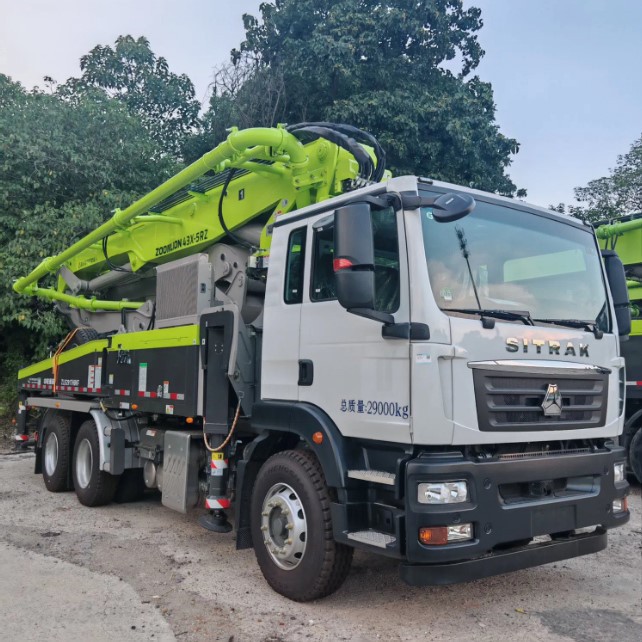
A concrete pump is a machine that uses pressure to continuously transport concrete along a pipeline. It mainly consists of a pump body and a delivery pipe. Structurally, it is mainly divided into piston (plunger) type and extrusion type. Based on the mode of movement, common types include trailer pumps (ground pumps) requiring towing, truck-mounted pumps with their own chassis, and pump trucks with integrated placing booms (sky pumps). Its main characteristics are high pumping pressure and long delivery distance, making it widely used in infrastructure construction such as housing construction, bridges, and water conservancy. Since achieving breakthroughs in domestic production in the 1990s, China's concrete pump industry has developed rapidly, reaching world-class levels in high-pressure pumping and long boom technologies, and dominating the global market.
Piston Concrete Pumps
These come in hydraulic and mechanical drive types. Hydraulic drive concrete pumps consist of a hopper, hydraulic cylinder and piston, concrete cylinder, distribution valve, Y-tube, flushing equipment, hydraulic system, and power system. The hydraulic system drives the piston to reciprocate through pressure. When the piston moves backward, it draws in material; when it moves forward, it forces the concrete from the concrete cylinder into the delivery pipe through the Y-tube. After pumping concrete, the pump body and delivery pipe are cleaned with high-pressure water or compressed air. The displacement of a piston concrete pump depends on the number and diameter of the concrete cylinders, the piston reciprocating speed, and the volumetric efficiency of the concrete cylinder intake.
Extrusion concrete pumps come in three types
Rotor-type (double roller), straight-pipe type (three roller), and belt-type (double groove). The rotor-type double roller concrete pump consists of a hopper, pump body, extrusion hose, vacuum system, and power system. The pump body is sealed, with two planetary rollers mounted on the rotor frame inside. The inner wall of the pump body is lined with rubber pads, and the extrusion hose is installed on the inner circumference of the pads. The power unit drives the planetary rollers to rotate, crushing the extrusion hose and forcing the concrete inside into the delivery pipe for discharge. The vacuum system maintains a certain vacuum within the pump body, causing the extrusion hose to immediately return to its original shape after crushing and accelerating the intake of concrete from the hopper into the extrusion hose. The displacement of an extrusion concrete pump depends on the rotor's rotation radius and speed, the diameter of the extrusion hose, and the volumetric efficiency of the concrete intake.
Hydraulic diaphragm concrete pumps consist of a hopper, pump body, diaphragm, control valve, pump, and water tank. The diaphragm is located within the pump body. When the pump draws water from below the diaphragm back to the water tank via the control valve, the diaphragm sinks, and concrete in the hopper forces open the check valve and enters the pump body. When the pump draws water from the water tank back to the pump body via the control valve, the pressurized water raises the diaphragm, closing the check valve and forcing the concrete into the delivery pipe for discharge.
Concrete pumps have high productivity, capable of completing both horizontal and vertical concrete transport in a single operation. However, certain requirements exist regarding the concrete mix proportions, aggregate size and gradation, cement dosage, and concrete slump to ensure good pumping efficiency.
Diesel engine powered concrete pumps
These meet the needs of field construction sites and other operating environments without a power source. During the pumping process, the diesel engine speed is detected by the speed sensor and transmitted to the control computer. Because the change in pumping pressure will cause a corresponding change in the diesel engine speed, the control computer controls the throttle motor to increase or decrease the throttle according to the detected speed change, and automatically adjusts the diesel engine to operate at the optimal speed.