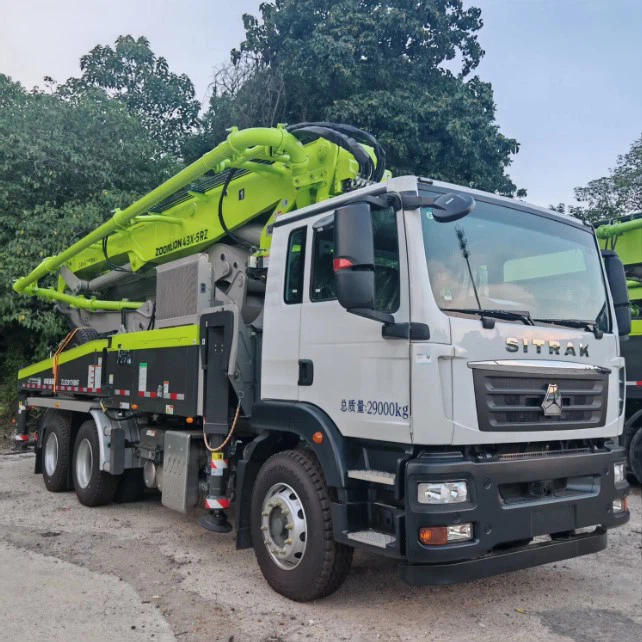
The primary function of a boom concrete pump is to automate the vertical and horizontal placement of liquid concrete. By integrating a hydraulic articulating arm (boom) with a high-pressure pumping system, it eliminates the need for manual hose handling, enabling rapid, precise, and continuous pouring in complex construction environments.
Core Functions
Automated Material Placement: The vehicle utilizes its multi-section boom to extend lines directly to the point of placement. This allows for the accurate delivery of concrete to specific locations, whether at significant heights, depths, or across wide areas, without manual intervention.
High-Efficiency Vertical Transport: It solves the logistical challenge of moving concrete against gravity. The system can pump mixtures to extreme elevations (reaching over 100 meters in advanced models) or deep underground, maintaining a consistent flow rate that far exceeds traditional crane-and-bucket methods.
Operational Versatility: The boom is designed to articulate, fold, and rotate (typically 360°), allowing the vehicle to navigate around obstacles and reach "blind spots" on a construction site. This flexibility ensures continuous pouring even in congested or restricted spaces.
Key Application Scenarios
High-Rise Construction: Essential for pumping concrete to upper floors of skyscrapers and residential towers where crane capacity is limited.
Large-Scale Infrastructure: Widely used in the construction of bridges, highways, and airports for pouring massive foundations and structural elements.
Complex Civil Engineering: Critical for specialized projects such as subway stations, tunnels, and hydraulic dams, where concrete must be placed in deep or confined environments.